
Introducing the Cohort : Part One
The Centre for Systems Practice, works with people trying to shift complex, stubborn problems across India, the kind that do not yield to a single fix because the real trouble sits below the surface. A problem like waste choking a river, or small enterprises that keep folding, is rarely just what it appears to be; underneath it usually sits a web of habits, incentives, and structures holding the visible problem in place.
Systems practice is the work of seeing that web clearly and then acting on it, and the Fellowship is where practitioners sharpen both skills.
The Fellowship runs for a year, built around residencies that bring the Fellows together to think, with the months in between spent back in their own field, testing what they are learning. This is its first cohort. They met for the first time in March 2026, and they arrived already deep in their problems, some with more than a decade behind them and some with less, but each having lived close enough to a problem, for long enough, to take it on. They come from very different fields and very different parts of the country, and that range is less a feature of the cohort than a feature of the work itself, which surfaces wherever people and systems meet. None of them are looking at these problems from a distance. They come to the Fellowship as peers in a shared inquiry.
At the centre of each Fellow's year is a pilot, their working bet on where the system can be moved. A pilot is not a finished solution, it is an experiment built to change as the residencies run and the Fellow learns what holds and what does not.
What you read here is where each of them stands at the first stage of that work, and some of it will look different a few months from now.
This is the first of three pieces introducing the cohort, and the series will keep returning to each Fellow as the year unfolds, following not just who they are but how their thinking and their pilots move.
Bharti Kumari Thakur, Kishanganj, Bihar

She calls herself a catalyst: someone who wakes up the potential sitting unused inside young people so they can begin to shape their own lives. An alumna of the local organisation Project Potential, she has spent five years in Thakurganj, in Kishanganj district in northern Bihar, building trust with young people, the panchayat, and government stakeholders, and she is now a CSP Fellow. The problem she has taken on is waste management, and the river running past the village is where its cost shows most plainly.
The Problem She Names
On the surface this looks like a river problem, and the river is dying. But the work is really about waste and the absence of any system to manage it. With no waste collection in the village, the rubbish from homes and the market, along with untreated drain water, empties straight into the river. The river is just where it all ends up, which is what makes it the place the whole community can see the damage. The way she sees it, the social fabric is going down with the water.
What She Sees
A thick mat of weed has spread across the surface, cutting off light and oxygen, and the fish are dying. The polluted water seeps into the groundwater that most households still drink from their handpumps, so the problem has reached people's bodies. In a survey of 150 households from her earlier work, 92 said their wastewater runs untreated into the river, and 71 said the women dispose of sanitary pads there for lack of any other option.
The part Bharti keeps returning to is that this is not really a garbage problem, it is a problem of how people think. A river has been treated for years as the easiest place to put what a household no longer wants, and the mindset that holds it there is stubborn: “it is a drain now, only the government can clean it, my one piece of waste will not matter.” The riverbank that once held gatherings and rituals has emptied out, and the everyday contact that holds a community together has thinned with it.
What She Is Working Toward
Bharti is not after a one-time cleanup, but a youth-led process that any young person, in any village can pick up and carry home: a way of managing a community's waste so it stops killing the water everyone depends on. Her campaign, the Nadi Mitra Abhiyan, or River Friends Campaign, is being shaped as that model, and like every pilot here it is still being worked out as she goes. The work starts at home with separating wet and dry waste, then builds outward to households, sanitation workers, and the panchayat moving together. From her immersion visits she has gathered the pieces, source segregation, citizen data collection, and scientific water testing, so the case she takes to the administration rests on evidence rather than complaint. And she wants women in the decisions, because the household is where waste begins and where the system has to live.
Badavath Venkanna, Gangaram Mandal, Telangana
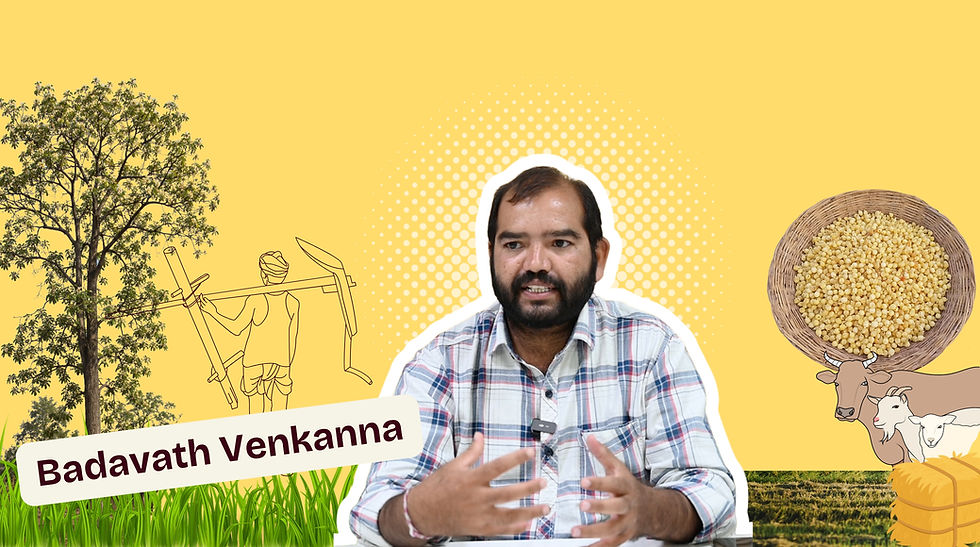
Venkanna works at the point where tribal livelihoods meet the land they depend on. His ground is Gangaram Mandal, in Mahabubabad district, an agency mandal under the Fifth Schedule of the Constitution, where about 94 percent of the population is Koya. He is strong at bringing communities together and at working through self-help groups (SHGs) and farmer producer organisations (FPOs), and he has helped promote more than 500 livelihoods across non-farm, food processing, and off-farm enterprises.
The Problem He Names
The mandal keeps producing the same condition. Livelihood insecurity, weak infrastructure, and limited access to basic services among tribal communities. It is made worse by land loss through contract farming, by environmental degradation, and by a climate that swings without warning, and the result is poverty, migration, and malnutrition. More than half the people, around 56 percent, migrate seasonally. About 90 percent of farming is rainfed, and most families depend on the forest for their secondary livelihoods.
What He Sees
Venkanna maps two frictions that keep the system stuck. The first runs between farmers and the forest department. Tribal families clear forest for podu cultivation, the department objects, and the access that the Forest Rights Act is meant to guarantee sits unresolved in between. The second runs between farmers and traders, where the person who supplies the inputs is often the same person who buys the crop. The harvest gets pledged as collateral before it is even grown, and the price paid stays below the market. Underneath both sits the same contradiction: a forest abundant in produce, and a community that is still food insecure, because that abundance is not being turned into anything that lasts.
What He Is Working Toward
Venkanna is looking at several connected paths rather than one fix. Watershed work, farm ponds, and check dams to hold water. Soil conservation, crop diversification, and bringing livestock back into the farm system. Value addition to what the forest already gives, so that non-timber forest produce like mahua, honey, and sal leaf becomes a finished product instead of a raw material sold cheap. The mahua laddu sits inside this idea, as one way a forest flower could become a small local enterprise. Around all of it he wants stronger producer collectives and processing units, women-led enterprises, and an approach that brings water, energy, enterprise, and markets into the same frame.
What he brings into the fellowship is the harder question underneath the laddu. How do you build livelihoods from what a community already has, in a way that holds for the long term, rather than spending that flows in and disappears?
Firdoushi Al Islam, Assam

Firdoushi works at the intersection of people and the systems meant to support them. For more than seven years she has worked with women entrepreneurs, youth, community institutions, and market actors in rural and small-town Assam, through field immersion, stakeholder consultations, and now systems practice.
The Problem She Names
Despite continuous support through training, resources, and institutions, women and youth enterprises in rural Assam often cannot sustain on their own. Enterprises get activated, but the ecosystem conditions that would let them last stay fragmented, shaped by socio-economic vulnerability, weak market integration, limited access to networks, and isolated ways of working. The same outcomes keep returning. Low and irregular income, dependence on outside support, weak market continuity, and a slow drop in confidence among the people running the enterprises.
What She Sees
Across years of this work, Firdoushi kept watching the same pattern. People would make progress, and the progress would not hold. Training was delivered while market access stayed weak. Continuous handholding, meant to help, turned into dependency, until motivation dropped and businesses folded. Then the cycle would start again with a new group of women stepping into the same shape of disappointment the last group had just left.
She is careful about what this means. The challenge, she now says, is not really about entrepreneurship skills. It is about everything that surrounds the entrepreneur. The dependence on the supporting organisation, the demands of the household, the social norms that decide what a woman can do with her time, and the access to knowledge and finance that should be ambient and is not. The problem is not that people are not trying hard enough. It is that the system around them is still learning how to meet them.
What She Is Working Toward
Firdoushi is open that she does not have a fixed solution yet, and the fellowship is the space she is using to step back and look at the system itself. What she is moving toward has a clear shape even if the design is still forming. She wants an enterprise ecosystem in rural Assam that is resilient, that does not depend on someone always standing behind it, and that produces change which actually lasts. She is drawn to collective market access, to pairing women's production knowledge with the digital and logistics skills of younger people, to community-based finance, peer networks, and value-chain work. She studies models that have done versions of this well, like the Palash collective in Jharkhand, Mann Deshi, and Rangsutra. The question she keeps sitting with is how to enable real autonomy in a setting where the surrounding system has, for years, been the thing doing the holding.
Suraj Singh, Bikaner, Rajasthan

Suraj calls himself a system learner. He has spent more than six years with farming and pastoralist communities in the Thar Desert, and what drives him is a question about whether desert farming can be reimagined so that it restores the soil and strengthens livelihoods at the same time.
The Problem He Names
Farming in the Thar is becoming unsustainable. The soil is losing fertility, water is under stress, chemical use is climbing, costs keep rising, and incomes stay low. The Indira Gandhi Canal sits at the centre of the paradox he describes. When it arrived it improved irrigation and production, but with little attention to sustainable practice, value addition, or the wider ecosystem. Over time it pulled farmers toward water-hungry, input-hungry cash crops in a place that is still a desert.
What He Sees
In the canal area he has watched a near-total shift away from traditional crops toward groundnut and cotton, both thirsty and input-intensive. Rainfall is erratic and winters are shrinking. Every year the canal closes for about two months, which leaves the Rabi crop exposed and, without water storage to fall back on, often failing. Dependence on fertilisers, pesticides, and groundwater keeps rising, and soil organic carbon has fallen to around 0.17 to 0.18. Most farmers borrow for their inputs from local money lenders. Women carry much of the farm labour while holding little say over the income or the decisions it pays for. And the systems that should work together, agriculture, water, livestock, markets, and rural development, mostly operate apart.
He pays close attention to the beliefs holding it all in place. A farmer's job is only to grow, and the trader will handle whatever comes after. Chemical farming is modern farming. The moneylender helps us by giving credit. Each one makes sense to the person who holds it, and together they keep the cycle turning.
What He Is Working Toward
Suraj believes meaningful change must begin where the agricultural system is most fragile and often overlooked: the soil. From this foundation, he is building a regenerative, ecosystem-based approach tailored to the Thar Desert, promoting bioregion-specific farming practices that restore soil health while gradually reducing dependence on chemical inputs, without exposing farmers to sudden yield losses during the transition.
To make these practices practical and scalable, he integrates appropriate farm technologies that reduce drudgery & cost, enabling farming families to adopt sustainable methods with greater ease and efficiency. At the heart of this vision is a strong farmer-owned institution that mobilises communities, provides access to local processing and value addition, and connects farmers directly with markets to secure fair and stable incomes.
In Closing
These four fellows work in four very different geographies, on problems that look nothing like one another on the surface. What connects them is a conviction that patient, place-based work is the kind that holds.
Bharti is shaping a method any young person can carry home to deal with a community's waste before it kills the water it depends on.
Badavath is mapping how a forest economy could give a community a reason to stay. Firdoushi is slowing down to redesign what enterprise support has to become if change is going to last.
Suraj is beginning with the soil, and refusing to stop until the farmer beside it is no longer at the losing end of anything.
The fellowship gives each of them the room to think more carefully while they keep doing the work they have been doing for years. Over the coming months we will keep returning to all of them, to the systems they are mapping, the questions they are sharpening as they go, and the shape of what they are building back home.

If you would like to know more about our Fellows or ask them specific questions, write to us at info@centreforsystemspractice.org!
The Centre for Systems Practice is a SELCO Foundation initiative. If this piece was useful, our newsletter goes out every month with one piece of practical thinking from the field.


Comments