
What’s the least you need to start? The Minimum Viable System
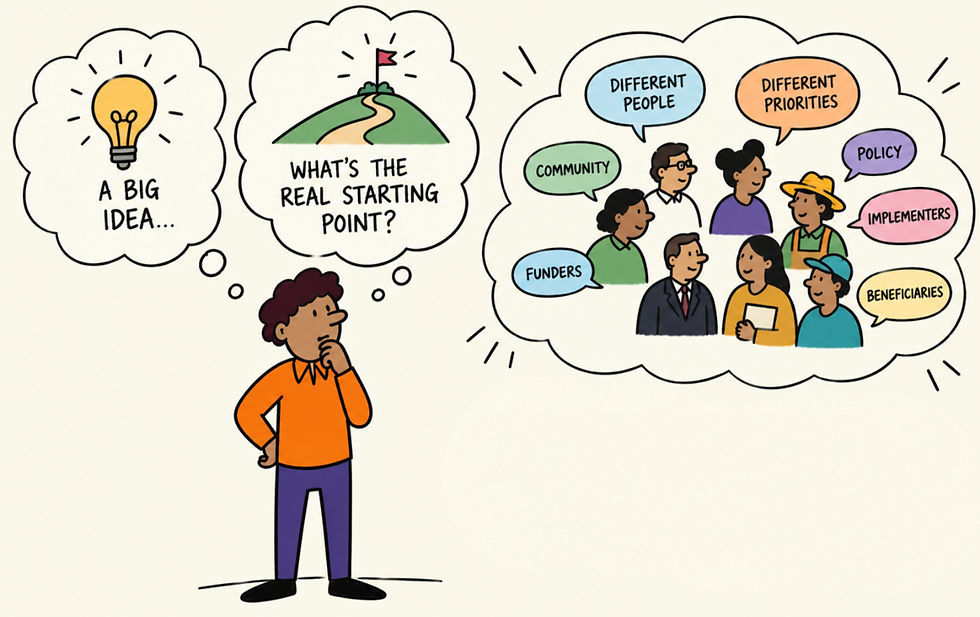
What does it actually take to get a big idea off the ground? Is there a first step, smaller than the whole vision, that has to happen before anything else? What is the real starting point, when a change involves many different people and priorities?
Imagine someone trying to bring solar-powered aerators to fish farmers in a new district in Assam. These devices pump oxygen into fish ponds and can dramatically improve yields. But to make this work at scale, one needs a lot of people on board: the state fisheries department, banks willing to lend money for the equipment, researchers who can train farmers properly, a technology supplier, an NGO the community trusts, and of course, the farmers themselves.
So where does one begin when dealing with different players and priorities?
The instinct is to try to bring everyone together at once. But big coalitions of people who do not yet trust the idea tend to produce long meetings and very little action.
A simpler way to think about this is: what is the smallest number of people who actually need to say yes before anything can begin?
Start small on purpose

This idea has a name: the Minimum Viable System, or MVS. It borrows from the tech world’s idea of a “minimum viable product,” the smallest version of something you can build and test in the real world, rather than waiting until you have built every feature you eventually want.
Applied to real-world problems like getting new technology to farmers, the MVS brings in simplicity to big challenges. Picture it like lighting a fire. You do not need a bonfire’s worth of wood to get a flame going. A spark, some dry kindling, and a bit of shelter from the wind. Once that small flame is burning steadily, you can add bigger logs. Skipping straight to the big logs will smother the spark before it catches.
In the Assam fisheries example, the essential ingredients include:
Someone to hold the whole thing together: Every new effort needs one person or organisation willing to coordinate everyone else, keep relationships going, and take responsibility when things don’t go as planned. Without this, even a good idea drifts, because nobody is actually accountable for making it work.
Someone the community already trusts: This is usually a local community-based organisation or group with rapport. Farmers are not going to risk trying an unfamiliar piece of equipment because a government department told them to. They will try it because someone they already trust or who has been present in their village for years, vouches for it. Trust, rather than technology, is the real bottleneck here.
A handful of farmers willing to go first: A small group willing to be the first to try something new forms the proof that everyone else needs to see before they will believe it is worth doing themselves.
This is what one needs to start with: one coordinator, one trusted local anchor, a few willing pioneers. If even one of these three pieces is missing, the best advice would be not to start yet.
Big players join when they are ready

The bank, state government, or research institute cannot say yes to something that does not exist.
A bank doesn’t need an exciting pitch to lend money for new equipment. It needs evidence that farmers who tried this actually made more money and can repay a loan. A government department wants to see that something works on the ground before it commits policy support or programme funding to it. And a research institute needs a specific question worth studying, which only emerges once farmers are already using the technology.
These things only exist once the small starting group has been running for a while and has real results to show. In the first few months, the small trusted group gets moving quietly. A few months later, once there is genuine data, banks and government schemes have something real to respond to and can start getting involved. Later, once there is a working, visible example, researchers and training institutions have something worth studying and scaling. The small group created the evidence that made the bigger players’ involvement possible.
Look for what already exists before building something new
When people actually went looking, in the example from Assam, they found that most of the pieces they needed already existed in some form but weren’t working together.
A technology supplier was already selling similar equipment elsewhere. A local NGO was already active in the area and was trusted. And an early, informal version of a coordinator role was already emerging unofficially.
If something is completely missing, you have to build it from scratch, which takes time. But if something already exists, just aimed in a slightly different direction, your job is much smaller: you simply need to redirect it. In this case, the real work was to formalise the coordination that was already happening instead of inventing new roles.
Before assuming you need to build everything new, it is worth asking what pieces of the puzzle might already be sitting there.
The bigger idea

The same logic applies any time you are trying to get something new off the ground, whether that is a community project, a small business, or a new idea inside an organisation.
What’s worth considering is:
resist the urge to gather everyone at once - work out who actually needs to say yes first and let everyone else arrive later once there is something real for them to respond to
trust is the biggest thing standing between an idea and it actually happening
think about what evidence each future partner will actually need before they can say yes and focus on creating exactly that evidence
look around for what is already there, even in a rough or half-formed state - it is often easier to redirect existing energy than to create new energy from zero
The lesson underneath all of this: you do not need the whole system in place to begin. You need a spark, a bit of trust, and a few people willing to go first.
Try it yourself
Thinking about an idea you’d like to get off the ground? Use this short worksheet, adapted from the Centre for Systems Practice’s process for designing a Minimum Viable System, to find your own core three.
Step 1: Name your core three
Who holds this together? Name the person or organisation who would coordinate this effort and be accountable for it, even informally, if it started today.
Whose trust are you borrowing? Name the person or group whose standing in the community you would actually be relying on. Do they know it yet?
Who goes first? Name two or three people willing to try this before anyone else has agreed to. If you can’t name them yet, that’s the first gap to close.
Worksheet pointer
Distinguish between actors who are visible and actors who are structurally critical. It is tempting to name the most prominent institution in a district as your “trusted anchor.” But the person who actually enables adoption is subtle - a women’s self-help group leader, a retired schoolteacher, a respected health worker - someone whose relationships took years to build and cannot be substituted overnight. Naming the most visible actor is not the same as naming the one that is load-bearing.
Step 2: Check what already exists
Before assuming any of these three roles needs to be built from scratch, ask: is a version of this already happening informally, just not yet pointed at this specific idea? A coordinator role half-emerging, an NGO already present but focused elsewhere, a handful of people already curious - these are gaps that need redirecting, not building. That is usually the faster starting move.
If you can answer all three questions in Step 1, you likely already have a Minimum Viable System - even if it doesn’t look like one yet. If you can’t, that gap is exactly where to start. If you'd like a copy of the worksheet, or want to talk through a problem you're wrestling with, write to us at info@centreforsystemspractice.org.
The Centre for Systems Practice is a SELCO Foundation initiative. If this piece was useful, our newsletter goes out every month with one piece of practical thinking from the field.


Comments