
Self-organisation is when a group of individual parts, each following its own simple behaviour, creates a bigger pattern together, without anyone directing them from the top. Nobody designs the pattern. It comes together on its own, just from the parts interacting with the ones closest to them.
It's easy to mix this up with emergence, since the two ideas are closely related. They are not quite the same thing. Self-organisation is a way that order can form, parts interacting locally without anyone in charge. Emergence is the name for the new pattern once it appears. Self-organisation can produce emergent patterns, but not every emergent pattern needs self-organisation behind it. If you want to look at emergence on its own, we wrote about it separately in Emergence: What It Actually Means. Distributed control is closely related too, and explains part of why self-organisation is even possible, since order can only form locally like this because control was never concentrated in one place to begin with. We wrote about that separately in Distributed Control: What It Actually Means.
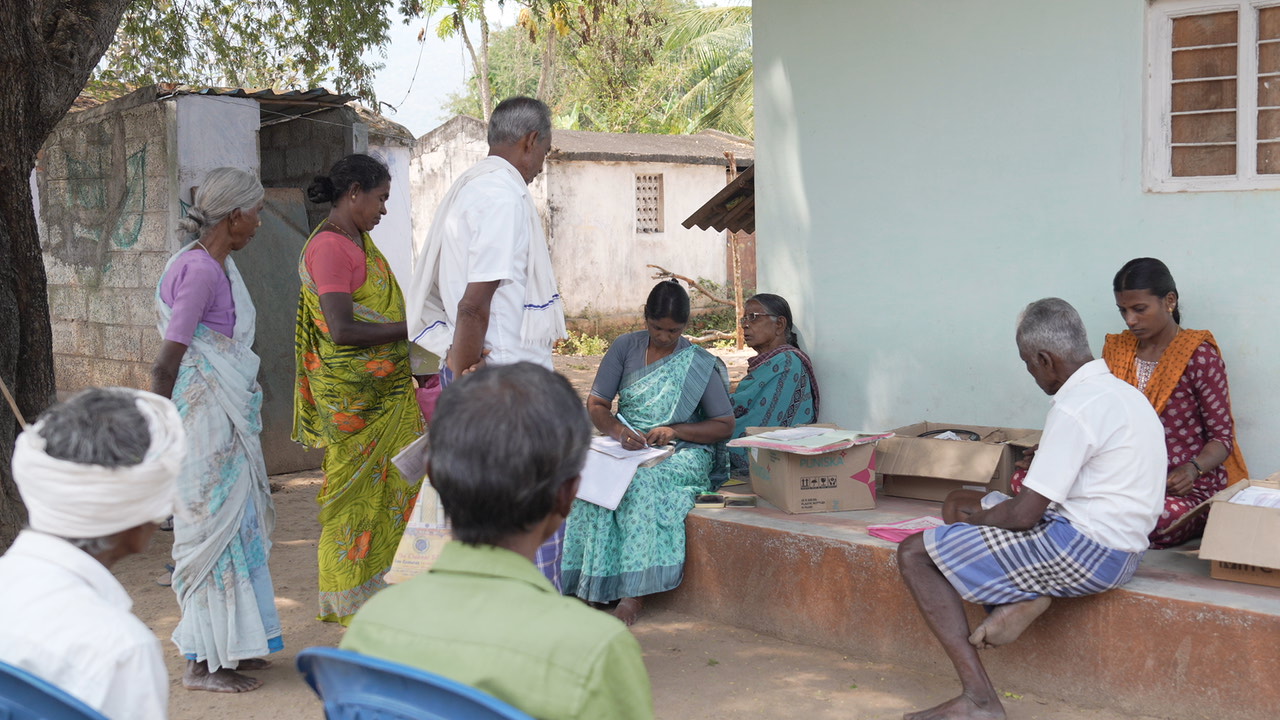
We described a real example of this before, without naming it. In How Do We Know Our Work Is Actually Working: Theory of Change, we wrote about the Tribal Health Initiative's hospital in Sittilingi valley. Day to day, the hospital is run by a Working Committee of senior nurses, lab technicians, and administrative staff. Nobody at the top hands them a rulebook for every decision. They coordinate with each other directly, based on what is in front of them, and the hospital keeps running smoothly as a result. The founders did not design the committee to work exactly this way from day one. It took shape on its own, out of years of local staff working alongside each other, and it has kept holding even as the founders' own daily involvement has reduced.
Where You'll See It

The same pattern shows up in systems that have nothing to do with each other:
Shoals of fish and flocks of birds. Each fish or bird is only watching the ones right next to it. Nobody is leading the group, but the whole shoal or flock still moves and turns as one shape.
Lines forming on a crowded pavement. When people are walking in opposite directions, lanes form on their own. Nobody arranges people into lines. It happens simply because each person keeps adjusting to the people closest to them.
The One Thing People Get Wrong About It
In development work, self-organisation sometimes gets treated as something you can switch on simply by stepping back. A programme ends, funding stops, or a partner organisation exits, and everyone assumes the community will now self-organise to keep the work going. That is not really what self-organisation means. Self-organisation is not the absence of support. It is the presence of enough real, local interaction that the pattern can hold on its own, whether anyone is watching or not. The fish, the birds, and the crowd on the pavement in each of these examples all end up more organised than they would look at first glance, not less.
Stepping back does not build self-organisation. Stepping back only tests it.

Key Takeaways
Simple, independent behaviour can create real order at a much bigger scale. No single fish or bird needs to understand the whole shape. It only needs to react to what is right next to it.
This order only needs local interactions to happen. Nobody needs the full picture. Order builds from each part responding to its own neighbours.
Order can hold even when part of the system is disrupted. Because nothing depends on one central controller, the pattern can often keep going even if part of it is removed.
Self-organisation and emergence are related, but not identical. Self-organisation can produce emergent patterns, but not every emergent pattern needs self-organisation behind it.
The next time something in your work looks coordinated, but nobody remembers deciding on the coordination, it might not have been designed at all. It might have organised itself.
What would self organisation look like in your work? Tell us in the comments!
Related reading: Emergence: What It Actually Means · Distributed Control: What It Actually Means · How Do We Know Our Work Is Actually Working: Theory of Change